So, most of my life is computers and electronics. I develop software at my internship by day. I socialize through internet forums such as Gmail, Google+, and Blogger. I burn away spare time playing video games (primarily minecraft recently). The only time I don't use a computer is when sleeping and traveling to another place to use a different computer.
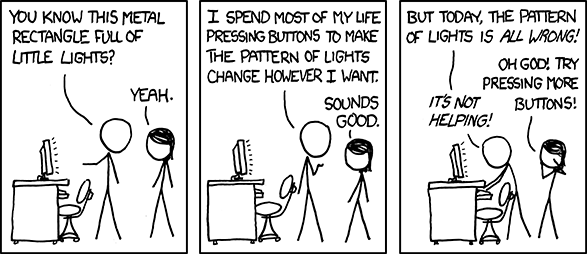
Obligatory XKCD:
Recently, I helped Loki (my girlfriend) build a desktop from parts (it is usually significantly cheaper) for the purpose of having a computer more powerful than a netbook (and minecraft). I helped put it together and all that jazz yesterday evening, and it is know running and everything appears to be functional. For those that are interested, here are some specifications:
$415 pricetag
Quadcore 3.2 Ghz CPU
320 GB 7200 rpm harddrive
8 GB ram
Video card
Radeon HD 4670
1 GB memory
albeit that it still needs a case (so it can move out of it's cardboard box home) and it still needs speakers (I plan to give her mine).
I just realized that I didn't really have a direction to go after that, all right,
ABRUPT TOPIC JUMP
I'm thinking about moving my blog to Google+. It is currently new and fancy, and I already use it, so it would be easier to consistently update followers on how post-secondary education and life is going. It also might encourage comments so I don't feel like a total loner writing these posts for myself and me.Currently G+ is "invite only," but in reality everyone I know on the service has over 100 invites, so people should respond if they care about this move.
Wednesday, August 10, 2011
Monday, August 1, 2011
Game Design Brain Dump
So, this is partially because I said I would, and partially because I want to write this all down in one place. There is going to be a lot of technical information, so feel free to not read this (actually, I think you should, that way I can exercise my non-existent authority over you).
Premise:
The goal of this project is to build a cross-platform modular role-playing game engine, capable of supporting many different flavors of campaigns and characters. I'm dropping the cross platform bit for the first revision (I'll be developing in Linux). At some point I may port the basic rule set to tabletop, primarily for playtesting, but that is a later goal.
Domains:
Physical, Mental and social are the three domains. Domains contain the following information:
physical mental social
power strength intelligence charisma
finesse dexterity wits manipulation
stamina constitution resolve determination
status location control emotions
state health mental state spirit (equivalent to hp, mp, etc)
quantity size magical energy spirit energy (measured in Joules)
makeup material knowledge preferences
specific names in the grid are subject to change, but these give the general idea.
Objects:
All objects in the game world are composed of some combination of the three domains. Examples:
A rock only has a physical domain, it's location is, in a field, and it's material is stone. str, dex and con determine physical properties (elasticity, density, hardness, and other derived statistics), which will be largely determined by material with slight variations. Standard humans will have all three components. Ghosts will have a mind and soul. Note: The intersection of status and physical can list ambient instead of a point.
Time:
I haven't thought this one through a whole lot, but here is what I have.
Technical: A main loop will go through all "time control objects" and give them a tick. These "time control objects" then distribute ticks down to objects for them to store and use ("time control objects" are allowed to distribute more or less ticks than they are given). The main loop will wait after distributing a tick until all "time control objects" say that it is okay for time to proceed.
Observed (hopefully): The game will run in real time with movement and such. Most selections will be made through menu. There will be spell effects that can change the flow of time, as haste, slow, and timestop. Battles will be done in a turn based manner, where all outside of the battle proceed at a slower time pace.
Actions:
All objects are capable of performing actions (although many may choose not to (e.g. rock)). A list of possible actions and consequences will be a plug-in set based on the campaign. All actions are set within a particular domain. The success level of actions is determined in three dimensions: precision, power and speed. Attributes (power, finesse, stamina) in the associated domain determine a point in this 3-space, which is added to a vector created from choice (direction) and skill/effort (magnitude). Points in speed will iteratively reduce/increase the time to complete an action. Points in precision and power will be handled by the descriptive text. Objects will be able to exert themselves (damage state) to increase success (the effort component). If success is put against a defense, a portion of the listed effect will take place, which can possibly be tiered.
Un-handled portions:
effect of implements and tools (probably add additional skill, and maybe effect attributes)
how skill and effort interact to create vector
taking extra time to improve success (instead of hindering it)
Other Notes:
knowledge will contain player skill values
when a player casts a spell, they create a mental object with special knowledge entries creating/imbuing listed effects
experience will contain player XP, which will be handed out by GM as of current
skills can be linked together so that knowing one thing, makes advancing another easier
Subscribe to:
Posts (Atom)
